Famous Biologists
A history of biology in biography

|

EUGENE M. MCCARTHY, PHD
This section, Famous Biologists, offers biographies describing the lives, contributions, and discoveries of renowned biologists from all eras of biology.
| Select page: |
| 1 | 2 | 3 |
Louis Agassiz (1807-1873). Swiss-born American zoologist, geologist, and paleontologist, with a special expertise in ichthyology. Founder and director of Harvard's Museum of Comparative Zoology, one of the most famous scientists of his day. Read more >>
Ulisse Aldrovandi (1522-1605). Italian naturalist and physician. Together with Conrad Gesner, he led the Renaissance movement that put a new emphasis on the study of the nature. Read more >>
Mary Anning (1799-1847). British paleontologist. Often described as the greatest fossil hunter ever known. Read more >>
Werner Arber (1929-). Swiss microbiologist and geneticist. Shared the 1978 Nobel Prize in Physiology or Medicine with Hamilton Smith and Daniel Nathans for the discovery of restriction endonucleases, which led to the development of recombinant DNA technology. Read more >>
Aristotle (384-322 B.C.). Greek philosopher and early scientist. Often called the "father of biology." Read more >>
FAMOUS BIOLOGISTS (B)
Karl Ernst von Baer (1792-1876). German biologist and scientific explorer. One of the founders of embryology, von Baer discovered the notochord and the embryonic blastula. Read more >>
David Baltimore (1938-). American biologist. Shared the 1975 Nobel Prize in Physiology or Medicine with Howard Temin and Renato Dulbecco for their discovery of reverse transcriptase.
Read more >>
George Beadle (1909-1975). American geneticist. By means of x-ray irradiation of the mold Neurospora crassa and screening of the resulting mutants, Beadle showed, with Edward Tatum, that mutations induced in genes corresponded to alterations in specific enzymes. This finding led to the acceptance of the one gene/one enzyme hypothesis. Shared with Tatum half the 1958 Nobel Prize in Physiology or Medicine. Read more >>
FAMOUS BIOLOGISTS (C)
Erwin Chargaff (1905-2002). Austro-Hungarian-born American biochemist whose experiments provided crucial information allowing Watson, Crick, and Wilkins to elucidate the double-helix structure of DNA. Read more >>
Georges Cuvier (1769-1832). French naturalist and zoologist. Founder of the fields of vertebrate paleontology and comparative anatomy. One of the most prolific authors of scientific literature in the history of biology. Read more >>
FAMOUS BIOLOGISTS (D)
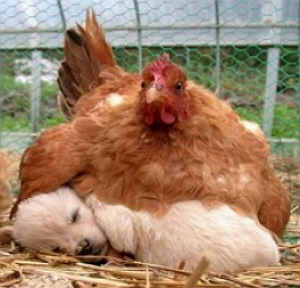 Dog-chicken hybrids?
Raymond Dart (1893-1988). Pioneering paleoanthropologist. Discoverer of the Taung Child, he was the first scientist to provide hard evidence that humans first evolved in Africa. Read more >>
Charles Darwin (1809-1882). English naturalist. One of the most famous scientists who ever lived. His book, On the Origin of Species, convinced many of the reality of evolution. Remembered for the theory of natural selection, the credit for which he had to share with Alfred Wallace, who formulated it independently. Read more >>
A Short Biography of Charles Darwin >>
Charles Darwin facts — Basic facts about Darwin >>
Darwin Jokes — Jokes told by Charles Darwin >>
The author, Eugene M. McCarthy, is a biologist living in Athens, Georgia, USA. He welcomes comments and suggestions. Please pass them along through the contact page.
| Select page: |
| 1 | 2 | 3 |