Charles Darwin's Autobiography

|
| < | Famous Biologists | > |
|
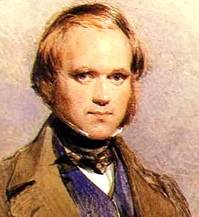
| Charles Darwin as a young man |
The first and, in some ways, the best biography of Charles Darwin was written by Darwin himself. To fill out the story, Darwin's original text is here offered with added illustrations, links, and explanatory notes. The notes are either inserted at the bottom of each page or, more often, into the text itself (in square brackets).
|
Contents:
|
For those who tire of the unrelenting adulation found in the biographies of Darwin produced by other writers, the autobiography may come as something of a relief — unlike his other biographers, Darwin is actually willing to criticize himself from time to time. The story, as he tells it, also has the large advantage of being told from the standpoint of what he himself saw as significant in his own life.
First published in The Life and Letters of Charles Darwin (Francis Darwin, ed., 1887. London: John Murray), the autobiography was written in 1876, except for the addendum, written in 1881. The first page of the original is dated May 31st, 1876, and bears the title Recollections of the Development of my Mind and Character. This short biography of Charles Darwin — a summary of his life expressed in his own words — reads as follows:
A GERMAN EDITOR having written to me for an account of the development of my mind and character with some sketch of my autobiography, I have thought that the attempt would amuse me, and might possibly interest my children or their children. I know that it would have interested me greatly to have read even a short and dull a sketch of the mind of my grandfather [Dr. Erasmus Darwin (1731-1802), a free-thinking atheist, who died before Charles was born], written by himself, and what he thought and did, and how he worked. I have attempted to write the following account of myself, as if I were a dead man in another world looking back at my own life. Nor have I found this difficult, for life is nearly over with me [Darwin died April 18th, 1882]. I have taken no pains about my style of writing. [The autobiography ends with the following note: "Aug. 3, 1876. This sketch of my life was begun about May 28th at Hopedene¹, and since then I have written for nearly an hour on most afternoons."] (continued >>)
Note:
1. Hopedene was Hensleigh Wedgwood's house in Surrey.
Most shared on Macroevolution.net:
Human Origins: Are we hybrids?
On the Origins of New Forms of Life
Mammalian Hybrids
Cat-rabbit Hybrids: Fact or fiction?
Famous Biologists
Dog-cow Hybrids
Georges Cuvier: A Biography
Prothero: A Rebuttal
Branches of Biology
Dog-fox Hybrids