Carolus Linnaeus
Biography
EUGENE M. MCCARTHY, PHD
|
For better or worse, Linnaeus dominated eighteenth-century biology.
—William T. Stearn†
|
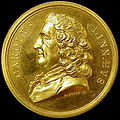
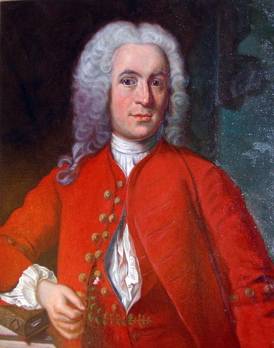
Carolus Linnaeus (23 May 1707 – 10 January 1778), also known as Carl von Linné or Carl Linnaeus. Swedish botanist, zoologist, and taxonomist. Established conventions for naming living organisms still in general scientific use today—in particular, he popularized binomial nomenclature, which had first been developed by the Bauhin brothers (Gaspard and Johann Bauhin) more than a century before. He was the first to use binomial names consistently. As a young man he was a creationist, but he later developed an evolutionary theory of his own.
Carolus Linnaeus was born at Stenbrohult, in the province of Småland in southern Sweden. His father,
Nils Ingemarsson Linnaeus (1674-1748), was a gardening enthusiast, and his interest in plants seems to have rubbed off on his son. His parents wanted Linnaeus to enter the priesthood, but in the end his teachers told them that he was unsuited to that profession. He then came under the wing of Dr. Johan Stensson Rothman, a physician in the nearby town of Växjö, who thought he might instead become a doctor. It was Rothman who introduced Linnaeus to botany as part of his initial training in medicine. (At that time it was nothing strange for medical students to study plants, since doctors were expected to be familiar with medicinal herbs.)

|
|
Killian Stobaeus (1690-1742) |
He entered the University of Lund in 1727, but found the instruction there in botany and medicine woefully inadequate. He did, however, manage to lodge with a local physician, Dr. Kilian Stobaeus, who had a keen interest in natural history. He spent "many enjoyable hours in the Doctors's cabinet of minerals, shells, birds and pressed plants," writes his biographer Wilfrid Blunt (1971, p. 23), "and was fascinated to observe the way in which the herbarium specimens were mounted," an experience that no doubt did much to stimulate his lifelong interest in collecting and classifying. Stobaeus also had an extensive library, and his student lodger borrowed many volumes and perused them late into the night. In his spare time, Linnaeus explored the flora of the surrounding region, together with other students who shared the same interests.
But when Dr. Rothman eventually came for a visit, he soon decided Lund was no good for his protégé and suggested that Uppsala University would provide him with a better medical education. So on August 23, 1728 his young student set out on the 400-mile journey to Uppsala. But even there, the medical training turned out to be poor, and Linnaeus ended up focusing his attention primarily on collecting and studying plants. Indeed, by 1730, he had become competent enough to join the faculty and begin lecturing on botany. But his medical training had scarcely advanced.

|
| In Lapp clothing |
Two years later he made an expedition to Lapland in northernmost Scandinavia, a region then almost unknown to European science. There he made an inventory of the plant life and investigated the indigenes, the Lapps. He later posed for a famous portrait (left), in which he is dressed in Lapp garb and holds a shaman's drum.
In 1734 he mounted a similar survey expedition, but this time to central Sweden. For this journey the city of Falun was his base, and when he returned, he lived for months with Baron Nils Reuterholm, the local governor. During this time he tutored the baron's younger sons in mineralogy and began to write an account of his travels, but he was always short of money.
During the Christmas holidays that year he was staying at the family home of one his student friends, Claes Sohlberg, there in Falun, when he met his wife-to-be, Sara Elisabeth (Sara Lisa) Moraea, at a party. She was the daughter of a well-to-do local doctor. By mid-January he had proposed and been accepted, though it wasn't clear how they would ever afford to marry.
But Claes' father had suggested that Linnaeus accompany his son to Holland and, for a salary of 300 copper dalers a year, coach him during their time there. Holland was at that time a leading center of learning with great universities and fine gardens stocked with plants brought from all over the world. Another attraction for Linnaeus was that some of the best printers were in Amsterdam. So, even though the elder Sohlberg eventually reneged on the offered salary, on April 15, 1734, Linnaeus and his friend set out for the Netherlands.

|
| Linnaeus Tower, Harderwijk |
During his time at Uppsala, Linnaeus had never been able to get a medical degree. So now, one of the first things he did upon arrival in Holland was simply to purchase one at a diploma mill. He fixed on the now defunct University of Harderwijk, apparently because it allowed students submitting a written thesis on any medical topic to graduate in as little as a week. As Blunt (1971) explains, Linnaeus, after staying a few days in Amsterdam,
And sure enough, on June 23, 1735, just six days after his arrival, he received his Doctor of Medicine. Originally, it seems Linnaeus had pictured a relatively brief sojourn in Holland, but acquaintances he had made in Amsterdam, particularly Albertus Seba and Johannes Burman, convinced him to remain. In the end, he stayed three years.
|
Other early naturalists:
|
There he supervised the publication of the first edition of the Systema Naturae (the slim beginnings of what would in later editions become his vast catalog of nature), the Genera Plantarum (which describes 935 plant genera), and the Flora Lapponica, where he reported on the plants he had found in Lapland.
It was in the 1735 edition of the Systema Naturae that he made the memorable decision to group apes and human beings in the same category, something no other naturalist had dared to do. This classification was important in prompting later writers to propose that humans had actually evolved from apes.

|
|
Woodcut title vignette from the Systema Naturae
|
But by early 1738 he was hearing rumors that a rival suitor was making headway with Sara Lisa. He returned to Sweden in a rush to defend his matrimonial territory. Once there, however, he found himself a prophet in his own country and no longer the renowned naturalist he had been in Amsterdam. He could not get a position as a botanist, which would have suited his training.
Faced with the need to make a living if he was ever to marry Sara Lisa, whose parents did not much approve of the match, he fell back on his purchased medical degree and set himself up as a doctor. For months no one consulted him. Word of his lack of medical experience had gotten around. But eventually, desperate men suffering from gonorrhea and syphilis came to him for advice. He didn't know what to tell them and wrote to a doctor friend in France — with the grand epithet, François Boissier de Sauvages de Lacroix — who recommended a mercury ointment that proved so effective that Linnaeus was soon swamped with customers. As he commented in a letter to an old friend, Carl Mennander,
And then he had a stroke of such good luck that it changed his life forever. The wife of a certain senator came to him about a persistent cough and he prescribed gum tragacanth lozenges. They worked so well that she touted them to Queen Ulrika Eleonora. All the court was soon agog at the clever young physician. The result was his appointment as Physician to the Admiralty, a large, secure income, and the favor of the aristocracy. Later he was even appointed Professor of Practical Medicine at the University of Uppsala. His modest investment at Harderwijk had yielded a golden return.

|
|
Sara Lisa Moraea (1716-1806) |
Thus, he was able to marry Sara Lisa in 1739 and to continue with his great inventory of life. With the aid of correspondents who sent him specimens from all corners of the globe, he greatly expanded the number of plants and animals recognized by science. These were all assigned a place in what was to become known as the Linnaean taxonomy, the first version of the system of scientific classification employed by biologists today. For many of these he coined names that are still in general use, including the scientific name for human beings (Homo sapiens).

|
|
Daniel Solander (1733-1782) |
In carrying out his work, he visited many public and private collections in Europe. But he wanted to be as exhaustive as possible, so he maintained a correspondence with naturalists throughout the world, who were happy to report to him and have their work recognized. He also sent students out on far-flung voyages in search of novel specimens. For example, Daniel Solander sailed with Captain Cook on his first voyage round the world and became the first university-trained scientist to set foot on the Australian continent, as well as the first Swede to circle the globe.

|
In the Systema Naturae ("The System of Nature"), he not only classified plants and animals within two kingdoms (Regnum animale and Regnum vegetabile), but also placed minerals in a third kingdom (Regnum lapideum). Within Regnum vegetabile, plants were grouped according the number of their stamens and pistils. The tenth edition of this book (1758), the one in which animals are first assigned binomial names, is considered the starting point of zoological nomenclature.

|
| Species Plantarum (title page) |
The first edition of Species Plantarum ("The Species of Plants") was published in 1753. This work is the beginning of all formal botanical taxonomy. No plant names appearing in any earlier literature are now considered to be validly published. In it, a binomial nomenclature for plants is used consistently for the first time. However, the groupings he created for plants have largely been abandoned in modern classification.
The divisions into which he placed animals have held up rather better, although many changes have since been made. But Linnaeus was far more important as a deviser of means, than as an achiever of ends. His method of classification was widely embraced by all naturalists, and in a somewhat expanded form remains the standard among biologists today.
Major works: Systema naturae (1st ed., 1735); Genera Plantarum (1737); Flora Lapponica (1737); Flora Svecica (1745); Fauna Svecica (1746); Species plantarum (1st ed. 1753); Systema naturae (10th ed., 1758).
Notes:
- Carolus Linnaeus is the latinized form of his name that he used in academic publications. He was also known as Carl Linnaeus, as Carl von Linnè (adopted after 1762, the year he was granted nobility in recognition of his scientific work), and as Carl Linné (the way he often signed his name late in life). If his father had not attended college (at the University of Lund), his name would have been Carl Nilsson (Carl, son of Nils) because his father's name was originally Nils Ingemarsson (Nils, son of Ingemar). At the time, this was the accepted naming convention among Swedes. However, when Nils registered at the University of Lund he had to register under a family name. So he coined the name Linnaeus, which was later used also by his son Carl. Nils took the name Linnaeus from the Smålandish dialect word linn, meaning linden tree. In Sweden an ancient tree on the family property would be singled out as the "warden tree," which in Norse tradition was a tree that exerted a protective power over the family home. In the case of their family, the warden tree was a linden. The family farm was known as Linnagård.
- Carolus Linnaeus was one of the founders, and the first president, of the Royal Swedish Academy of Sciences (Kungliga Vetenskapsakademien).
† Quoted in Blunt (1971, p. 11).
Work cited:
Blunt, W. 1971. The compleat naturalist: A life of Linnaeus. New York: Viking.