Homo ergaster
Online Biology Dictionary

|
EUGENE M. MCCARTHY, PHD
|
|
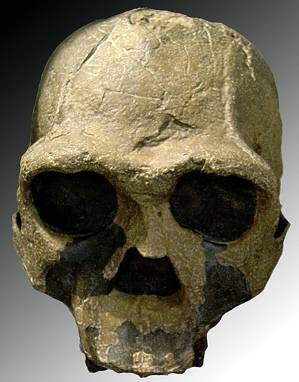
Homo ergaster Credit: Luna04 |

Fossil material assigned to this hominid ranges from about 1.4 to 1.9 million years in age (early Pleistocene) and was unearthed in eastern and southern Africa. The younger specimens assigned to ergaster are usually found associated with Acheulean tools.
This early human was first described by Groves and Mazak (1975). However, a mandible found in southern Africa in 1949 was reported by South African palaeontologist John T. Robinson well before Groves and Mazak began their work. At the time he named Telanthropus capensis, but it was later reclassified as H. ergaster. The name ergaster means "working" — referring to the use of tools — so the scientific name of this hominid means "working man."
Homo ergaster: Invalid?
As a category ergaster is problematic, given that the different individual paleoanthropologists accepting it as valid do not agree on which fossils should be assigned to it. As Wikipedia puts it, "Homo ergaster is variously thought to be ancestral to, or as sharing a common ancestor with, or as being the same species as, Homo erectus," a rather murky evaluation of this hominid's status. But the recent discoveries of Homo georgicus specimens at Dmanisi, which are quite variable even though they are all from the same site, suggest that the georgicus specimens and all the hominid finds in Africa contemporary with the georgicus fossils, including those assigned to ergaster, should be assigned to a single variable Homo erectus.Researchers who assert the validity of ergaster usually suggest hominids of this type were more similar to modern humans than was Homo erectus. However, many experts are now inclined to believe fossils attributed to ergaster really belong either to Homo habilis or Homo erectus, primarily the latter — ergaster fossils date to a period when habilis and erectus overlapped in time (see human evolution timeline).
Perhaps we are not from the apes alone?
|
Australopithecus bahrelghazali >>
Most shared on Macroevolution.net:
Human Origins: Are we hybrids?
On the Origins of New Forms of Life
Mammalian Hybrids
Cat-rabbit Hybrids: Fact or fiction?
Famous Biologists
Dog-cow Hybrids
Georges Cuvier: A Biography
Prothero: A Rebuttal
Branches of Biology
Dog-fox Hybrids