Dog-fox Hybrids
Mammalian Hybrids
|
But if a fox bears the seed of a dog, that which is born is not a dog, but a blending of something from both species.
—Galen, De Semine 2.1 (2nd cen. A.D.)
|
(This article is part of the support material for the alternative theory of evolution offered on this website.)
 Enlarge image
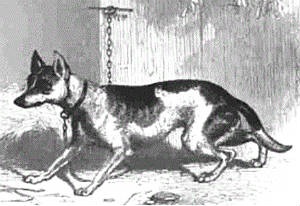 One of the many dog-fox hybrids reported in the older literature (Walsh 1859, p. 165)
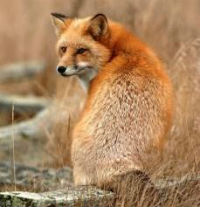 Red Fox (Vulpes vulpes)
Image: Minette Layne
Red Fox (Vulpes vulpes)
Image: Minette Layne
Although throughout much of the Northern Hemisphere extensive natural contact does occur between fox and dog, nearly all reports of dog-fox hybrids refer to crosses in captivity involving a male fox and a bitch (one seemingly reliable French report does describe two such hybrids shot by hunters). The short name for a dog-fox hybrid is a “dox.”
There is controversy over whether dog-fox hybrids are actually possible, and this cross is not very well documented. In particular, there seem to be no genetically verified dog-fox hybrids on record. Moreover, since dogs are so variable, naysayers can always claim that any putative hybrid falls within the range of variation of ordinary dogs.
The chromosome count of a red fox is 2n=34 (plus 3-5 micro-chromosomes) and that of a dog, 2n=78. So the difference in counts is large, with dogs having more than twice as many. This fact is often cited as somehow making such hybrids "impossible." But well-documented hybrids have been produced in many other crosses where the parents exhibit large differences in chromosome counts (for example, see the various equine crosses with large differences in parental chromosome counts documented here). In general, differences in the chromosome counts of the parents participating in a cross adversely affect the fertility of the hybrids, not their viability.
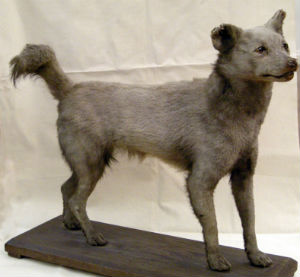
Chester. And, in fact, one fairly well-documented dox (see image at right above) is a stuffed animal in the collection of the Grosvenor Museum, (Chester, UK). It is as yet unclear, however, whether this specimen has been genetically verified as a genuine dog-fox hybrid. So the evidence in this case is perhaps not quite so good as in the next, which involves hybrids produced in captivity at a reputable institution.
Hannover. Wilhelm Niemeyer, Director of the Hannover Zoological Gardens, gives what appears to be an authentic account of the birth a litter of dog-fox hybrids (since it took place under strictly controlled conditions). In the 19th century, when Niemeyer reported this cross, it was normal practice at zoos to produce hybrids intentionally. For this reason, keepers at the Hannover Zoo arranged a mating between a dog and a captive fox. Niemeyer (1868, p. 69) says that “the fox, which was otherwise very tame, became fierce when the bitch, which was in heat,
Beyond the fact that this case occurred in captivity and was reported by the head official of an important zoo, Niemeyer’s account seems authentic because the hybrids described were inviable. In many types of crosses, a relatively small percentage of the hybrid offspring are sufficiently viable to reach adulthood. And yet, this elevated level of inviability seen in hybrid crosses should not obscure that fact that even in crosses where nearly all the hybrids die young, a certain fraction do survive.
Horncastle. Another seemingly credible account, entitled Fox and Dog Hybrids near Horncastle, is given by the Rev. J. Conway Walter in the April, 1899 issue of The Naturalist: A Monthly Journal of Natural History for North England (p. 104), which reads as follows: “I exhibited, when the Lincolnshire Naturalists’ Union met in Holbeck and Tetford, in August 1897,
 James Conway Walter
1831-1913
 Domestic Dog (Spitz)
Hellabrunn Zoo. Heinrich Heck (1932), the director of the Hellabrunn Zoo in Munich, Germany, describes a dog-fox hybrid produced from a cross between a female spitz and a male fox as reddish in color, but not so red as a fox (Darwin, 1868, vol 1, p. 31, states that “the Spitz-dog in Germany is said to receive the fox more readily than do other breeds.”). It had the gracile build of a fox, a similar gait, and the same restlessness. The long, fine hair of the shaggy coat showed the mother’s influence.
Worcester. Another article about a dog-fox hybrid was written by British zoologist Reginald Innes Pocock (1900):
 Reginald Innes Pocock
1863-1947
From the various foregoing accounts, it seems clear that foxes can interbreed with dogs and that a percentage of the resulting hybrids reach maturity. However, there is the additional question of whether those mature hybrids are ever fertile.
Article continues below
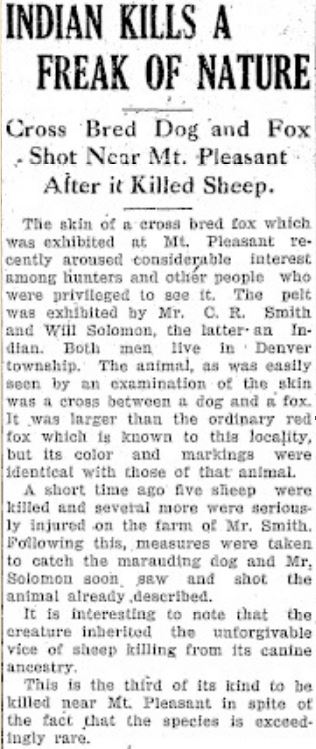 News notice about a dog-fox hybrid shot near Mount Pleasant, Michigan (Source: The Clare, Michigan, Sentinel (June 24, 1927, p. 1)
Accounts of fertile dog-fox hybrids
 Wolf-dog hybrids
John Henry Walsh F.R.C.S. (1810-1888) was an English surgeon and sports writer who wrote under the pseudonym "Stonehenge." In his book, The Dog in Health and Disease (Walsh 1859, p. 165), he comments that “it will be perhaps interesting to allude to the best authenticated specimen [of dog-fox hybrid] within my knowledge, which is now the property of Mr. Hewer of Reading. [This animal is pictured near the top of this webpage.] She is a daughter of the first cross which was described by Mr. Tomlin in ‘Bell’s Life’ in the year 1855, and is by an ordinary terrier dog.” He then goes on to quote Tomlin at length:
 Deer-cow hybrids?
Heck (1932) also says that a male dog-fox hybrid produced offspring with a female grey wolf (Canis lupus). Prichard (1836, p. 141) says, “Pallas (N. Nord. Beyträge) gives from Pennant two instances of generation between the dog and wolf and one between the dog and the fox, in which last the offspring, a female, afterwards produced young by a dog.”
Herbert (1837, pp. 339-340), too, gives an eye-witness account of a fertile hybrid. He states that “I have lately had under my observation a dog, whose father was a fox in an innyard at Ripon, and it has singularly the manners as well as the voice of a fox, but it is the parent of many families of puppies.”
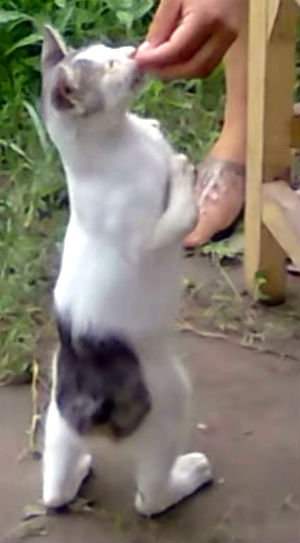 A screenshot from one of the many cabbit videos available on the internet. Note the plantigrade condition of the hind feet, which is normal for rabbits, but not cats. (Watch the video)
Eiffe (1892) provides yet another account, entitled Fox Hybrid:
So it would seem that the accurate statement is that, while dog-fox hybrids are much more rarely produced than pure foxes or dogs, frequently inviable and usually sterile, some are in fact produced, some are viable, and some are even able to produce offspring.
Dog-fox hybrids in antiquity
 Bear-dog hybrids
Dog-fox hybrids have been a topic since ancient times. They are mentioned by Aristotle (De Generatione Animalium, Bk. II, Ch. 4) and by Galen (De Semine, Bk. II, Ch. 1), among others. According to Platt (p. 241), Aristotle believed the “Laconian hound,” an ancient breed of dog, to be derived from hybridization between fox and dog. And Xenophon (On Hunting, iii) says,
And even pre-classical cultures were aware that dogs and foxes sometimes mate, as evidenced, for example, by Akkadian omen texts: “If a fox mates with a dog, the land will be destroyed” (Freedman 2017, p. 63) or “If a fox mates with a dog, prices will decline for three years” (ibid, p. 59). The Akkadian language was spoken in Mesopotamia as early as 3,000 B.C.
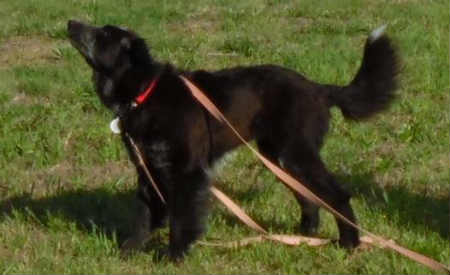 Picture of an alleged dog-fox hybrid recently sent in by a follower. Supposedly the cross involved a border collie and a silver fox. Note white tip of tail. The hybrid status of this animal has not been genetically confirmed.
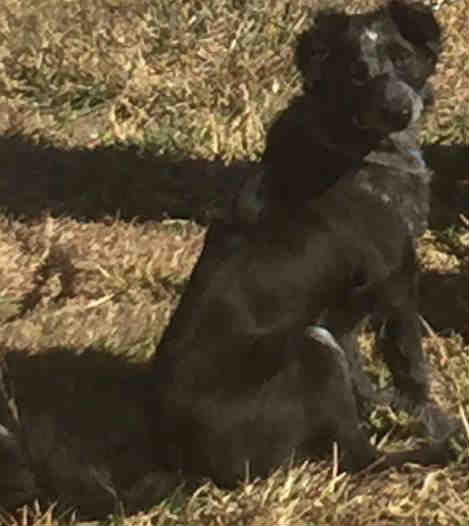 Another view of the animal pictured above.
Literature: Allgemeine Forst- und Jagd-zeitung, 1839 (no. 61, May 20, p. 244); Bechstein 1801; Cole and Shackelford 1946 (pp. 326-327); Darwin 1868 (p. 31); Eiffe 1892; Heck 1932†; Niemeyer 1868; Pocock 1900; Rafinesque 1821 (p. 115); Reuter 1924; Rörig 1903 (citing Niemeyer); Scaliger (1612, p. 648); Seton 1929; Wittmer 1925.
By the same author: Handbook of Avian Hybrids of the World, Oxford University Press (2006).