The Hybrid Hypothesis
2: The Other Parent
|
Teiresias: To you, I am mad; but not to your parents.
—Sophocles, Oedipus Tyrannus
|
(Continued from the previous section)
|
In a Los Angeles Review of Books article longtime science journalist Greg Critser examines the hybrid theory of human origins.
|
And why might one suppose that humans are backcross hybrids of the sort just described? Well, the most obvious reason is that humans are highly similar to chimpanzees at the genetic level, closer than they are to any other animal. If we were descended from F₁ hybrids without any backcrossing we would be about halfway, genetically speaking, between chimpanzees and whatever organism was the other parent. But we’re not. Genetically, we’re close to chimpanzees, and yet we have many physical traits that distinguish us from chimpanzees. This exactly fits the backcross hypothesis.
Moreover, in mammalian hybrid crosses, the male hybrids are usually more sterile than are the females. In a commercial context, this fact means that livestock breeders typically backcross F₁ hybrids of the fertile sex back to one parent or the other. They do not, as a rule, produce new breeds by breeding the first cross hybrids among themselves. Often, even after a backcross, only the females are fertile among the resulting hybrids. So repeated backcrossing is typical. Commonly there are two or more generations of backcrossing before fertile hybrids of both sexes are obtained and the new breed can be maintained via matings among the hybrids themselves. More backcrossing tends to be necessary in cases where the parents participating in the original cross are more distantly related.
Article continues below
| Genomic effects of backcrossing in a typical hybrid cross: |

|
Traits distinguishing humans from other primates
Mechanical Design Engineer
Guanajuato, Mexico
Many characteristics that clearly distinguish humans from chimps have been noted by various authorities over the years. The task of preliminarily identifying a likely pair of parents, then, is straightforward: Make a list of all such characteristics and then see if it describes a particular animal. One fact, however, suggests the need for an open mind: as it turns out, many features that distinguish humans from chimpanzees also distinguish them from all other primates. Features found in human beings, but not in other primates, cannot be accounted for by hybridization of a primate with some other primate. If hybridization is to explain such features, the cross will have to be between a chimpanzee and a nonprimate — an unusual, distant cross to create an unusual creature.
The fact that even modern-day humans are relatively infertile may be significant in this connection. If a hybrid population does not die out altogether, it will tend to improve in fertility with each passing generation under the pressure of natural selection. Fossils indicate that we have had at least 200,000 years to recover our fertility since the time that the first modern humans (Homo sapiens) appeared. The earliest creatures generally recognized as human ancestors (Ardipithecus, Orrorin) date to about six million years ago. So our fertility has had a very long time to improve. If we have been recovering for thousands of generations and still show obvious symptoms of sterility (see previous section), then our earliest human ancestors, if they were hybrids, must have suffered from an infertility that was quite severe. This line of reasoning, too, suggests that the chimpanzee might have produced Homo sapiens by crossing with a genetically incompatible mate, possibly even one outside the primate order.
For the present, I ask the reader to reserve judgment concerning the plausibility of such a cross. I’m an expert on hybrids and I can assure you that our understanding of hybridization at the molecular level is still far too vague to rule out the idea of a chimpanzee crossing with a nonprimate. Anyone who speaks with certainty on this point speaks from prejudice, not knowledge. No systematic attempts to cross distantly related mammals have been reported. However, in the only animal class (Pisces) where distant crosses have been investigated scientifically, the results have been surprisingly successful (399.6, 399.7, 399.8). In fact, there seems to be absolutely nothing to support the idea that inter-ordinal crosses (such as a cross between a primate and a nonprimate) are impossible, except what Thomas Huxley termed “the general and natural belief that deliberate and reiterated assertions must have some foundation.” Besides, to deny that inter-ordinal mammalian crosses are possible would be to draw, at the outset of our investigation, a definite conclusion concerning the very hypothesis that we have chosen to investigate. Obviously, if humans were the product of such a cross, then such crosses would, in fact, be possible. We cannot tell, simply by supposing, whether such a thing is possible — we have to look at data.
The Other Parent
DERMAL FEATURES
Naked skin (sparse pelage)
Panniculus adiposus (layer of subcutaneous fat)
Panniculus carnosus only in face and neck
In “hairy skin” region:
- Thick epidermis
- Crisscrossing congenital lines on epidermis
- Patterned epidermal-dermal junction
Large content of elastic fiber in skin
Thermoregulatory sweating
Richly vascularized dermis
Normal host for the human flea (Pulex irritans)
Dermal melanocytes absent
Melanocytes present in matrix of hair follicle
Epidermal lipids contain triglycerides and free fatty acids
FACIAL FEATURES
Lightly pigmented eyes common
Protruding, cartilaginous nose
Narrow eye opening
Short, thick upper lip
Philtrum/cleft lip
Glabrous mucous membrane bordering lips
Eyebrows
Heavy eyelashes
Earlobes
FEATURES RELATING TO BIPEDALITY
Short, dorsal spines on first six cervical vertebra
Seventh cervical vertebrae:
- long dorsal spine
- transverse foramens
Fewer floating and more non-floating ribs
More lumbar vertebrae
Fewer sacral vertebrae
More coccygeal vertebrae (long “tail bone”)
Centralized spine
Short pelvis relative to body length
Sides of pelvis turn forward
Sharp lumbo-sacral promontory
Massive gluteal muscles
Curved sacrum with short dorsal spines
Hind limbs longer than forelimbs
Femur:
- Condyles equal in size
- Knock-kneed
- Elliptical condyles
- Deep intercondylar notch at lower end of femur
- Deep patellar groove with high lateral lip
- Crescent-shaped lateral meniscus with two tibial insertions
Short malleolus medialis
Talus suited strictly for extension and flexion of the foot
Long calcaneus relative to foot (metatarsal) length
Short digits (relative to chimpanzee)
Terminal phalanges blunt (ungual tuberosities)
Narrow pelvic outlet
ORGANS
Diverticulum at cardiac end of stomach
Valves of Kerckring
Mesenteric arterial arcades
Multipyramidal kidneys
Heart auricles level
Tricuspid valve of heart
Laryngeal sacs absent
Vocal ligaments
Prostate encircles urethra
Bulbo-urethral glands present
Os penis (baculum) absent.
Hymen
Absence of periodic sexual swellings in female
Ischial callosities absent
Nipples low on chest
Bicornuate uterus (occasionally present in humans)
Labia majora
CRANIAL FEATURES
Brain lobes: frontal and temporal prominent
Thermoregulatory venous plexuses
Well-developed system of emissary veins
Enlarged nasal bones
Divergent eyes (interior of orbit visible from side)
Styloid process
Large occipital condyles
Primitive premolar
Large, blunt-cusped (bunodont) molars
Thick tooth enamel
Helical chewing
OTHER TRAITS
Nocturnal activity
Particular about place of defecation
Good swimmer, no fear of water
Extended male copulation time
Female orgasm
Short menstrual cycle
Snuggling
Tears
Alcoholism
Terrestrialism (Non-arboreal)
Able to exploit a wide range of environments and foods
Heart attack
Atherosclerosis
Cancer (melanoma)
Let’s begin, then, by considering the list in the sidebar at right, which is a condensed list of traits distinguishing humans from chimpanzees — and all other nonhuman primates. Take the time to read this list and to consider what creature — of any kind — it might describe. Most of the items listed are of such an obscure nature that the reader might be hard pressed to say what animal might have them (only a specialist would be familiar with many of the terms listed, but all the necessary jargon will be defined and explained). For example, consider multipyramidal kidneys. It’s a fact that humans have this trait, and that chimpanzees and other primates do not, but the average person on the street would probably have no idea what animals do have this feature.
Looking at a subset of the listed traits, however, it’s clear that the other parent in this hypothetical cross that produced the first human would be an intelligent animal with a protrusive, cartilaginous nose, a thick layer of subcutaneous fat, short digits, and a naked skin. It would be terrestrial, not arboreal, and adaptable to a wide range of foods and environments. These traits may bring a particular creature to mind. In fact, a particular nonprimate does have, not only each of the few traits just mentioned, but every one of the many traits listed in the sidebar. Ask yourself: Is it likely that an animal unrelated to humans would possess so many of the “human” characteristics that distinguish us from primates? That is, could it be a mere coincidence? It’s only my opinion, but I don’t think so.
Of course, it must be admitted that two human traits do, at first, seem to pose a contradiction. The animal in question lacks a large brain and it is not bipedal. An analysis of the relevant anatomy, however, reveals that these two human features can be understood as synergistic (or heterotic) effects, resulting from the combination (in humans) of certain traits previously found only separately, in the two posited parent forms. (The origins of human bipedality is explained in terms of the the hybrid hypothesis in a subsequent section. Another section offers an explanation of the factors underlying human brain expansion and, therefore, accounts not only for the large size of the human brain itself, but also for certain distinctive features of the human skull that are, themselves, obvious consequences of brain expansion).
Nevertheless, even initially, these two flies in the theoretical ointment fail to obscure the remarkable fact that a single nonprimate has all of the simple, non-synergistic traits distinguishing humans from their primate kin. Such a finding is strongly consistent with the hypothesis that this particular animal once hybridized with the chimpanzee to produce the first humans. In a very simple manner, this assumption immediately accounts for a large number of facts that otherwise appear to be entirely unrelated.
What is this other animal that has all these traits? The answer is Sus scrofa, the ordinary pig. What are we to think of this fact? If we conclude that pigs did in fact cross with apes to produce the human race, then an avalanche of old ideas must crash to the earth. But, of course, the usual response to any new perspective is “That can’t be right, because I don’t already believe it.” This is the very response that many people had when Darwin first proposed that humans might be descended from apes, an idea that was perceived as ridiculous, or even as subversive and dangerous. And yet, today this exact viewpoint is widely entertained. Its wide acceptance can be attributed primarily to the established fact that humans hold many traits in common with primates. That’s what made it convincing. But perhaps Darwin told only half the story. Scientists argue that humans are related to chimpanzees because humans share so many traits with chimpanzees. Is it not rational then also, if pigs have all the traits that distinguish humans from other primates, to suppose that humans are also related to pigs? Let us consider, then, the hypothesis that humans are the product of ancient hybridization between pig and chimpanzee. Given the facts presented in the discussion of stabilization theory on this website, it seems highly likely that humans are hybrids of some kind. This particular hypothesis concerning the nature of our parentage is, as we shall see, a fruitful one. For the present there’s no need to make a definite decision on the matter, but certain lines of reasoning do suggest the idea should be taken seriously:
|
I’m not saying pig DNA in the human genome “would not” be detectable. That’s putting words in my mouth. I’m saying “might not.” Or, better, “could easily have been missed without this guiding hypothesis.” You seem to be somehow assuming that it isn’t there. As far as I’m concerned, maybe it is, maybe it isn’t. But if it is, obviously, it’s not obvious. As to sequence data, in my opinion, your view of what constitutes evidence needs to be widened. It seems a bit much to insist that the only thing that can convince anyone of anything is sequence evidence. If that’s true, then law courts will have to throw out all the murder weapons, eyewitness testimony, alibis and everything else, and focus instead on DNA evidence alone, because DNA, if what you’re saying is true, is the only evidence that has any meaning. But you know that’s not right. And I think you therefore have to admit that you’re showing a certain bias here. Besides, I’m not making a strong statement. I’m only saying that, given the likely circumstances (an initial cross between chimpanzee and pig, followed by several generations of backcrossing to chimpanzee), analyzing the genetic data and reaching any strong conclusions is likely to be a pain. (A detailed discussion of the genetics touching on this question appears here.)
|
- First of all, the notion is set forward strictly as a hypothesis. No claim whatever is made that it is actually a fact that humans somehow arose through hybridization of pigs with chimpanzees. In contrast, proponents of the idea that humans are closely related to apes (and not to pigs) often speak as if their case has been proved beyond doubt. But, of course, it has not. The wide acceptance of this idea may actually be due to the lack of any competitive theory. I merely propose an evaluation of two distinct hypotheses by the usual scientific criterion: The hypothesis less consistent with available data should be rejected.
- Even if we could identify some objective unit of measure for “distance” or “similarity” (which is not at all a straightforward problem), we would still expect some crosses to be more distant than others — that is, the various types of possible crosses would constitute a continuum. Many would be “close” and some would be “distant.” But we would expect at least a rare few to be very distant. While these few might be rare, they might be among the most interesting, because they would offer an opportunity to obtain something radically different. Perhaps, it is only a subjective bias, but I believe that a human being, when taken as a whole, is radically different from a chimpanzee.
- On the other hand, if we first compare humans with nonmammals or invertebrates (e.g, crocodile, bullfrog, octopus, dragonfly, starfish), then pigs and chimpanzees suddenly seem quite similar to humans. Relative impressions of “close” and “far” are subjective and depend on context.
- Pigs and chimpanzees differ in chromosome counts. The opinion is often expressed that when two animals differ in this way, they cannot produce fertile hybrids. This rule is, however, only a generalization. While such differences do tend to have an adverse effect on the fertility of hybrid offspring, it is also true that many different types of crosses in which the parents differ in chromosome counts produce hybrids that are themselves capable of producing offspring. As Annie P. Gray noted in the preface to her reference work Mammalian Hybrids (1972, p. viii), which compiled information about all known hybrid mammals, “no close correlation was found between the chromosome count or the duration of gestation and the ability of species to hybridize.”
- There have been no systematic, scientific surveys of the crossability of mammals belonging to different taxonomic orders (a cross between pig and chimpanzee would be inter-ordinal). Any firm opinion on such a point must therefore, necessarily, be prejudiced. In fact, there is substantial evidence on this website supporting the idea that very distantly related mammals can mate and produce a hybrid (see the section on mammalian hybrids and, in particular, look at the videos shown there of ostensible rabbit-cat hybrids). Another relevant case involves ostensible hybridization between dog and cow. In addition, certain fishes belonging to different orders have been successfully crossed, and available information on mammalian hybrids indicates that various other extremely distant crosses have occurred. Evidence published in the journal Nature demonstrates that the platypus genome contains both bird and mammal chromosomes (Grützner et al. 2004). As Frank Grützner, the lead author of the study, stated in a related news story, “The platypus actually links the bird sex chromosome system with the mammalian sex chromosome systems.” How could this be the case if a bird and a mammal did not at some time in the past hybridize to produce a fertile hybrid? Such a cross would be far more distant than one between a chimpanzee and a pig (and platypuses are, of course, fertile — otherwise they would not be able to propagate themselves). And numerous hybrids between a primate (Homo sapiens) and the domestic pig (Sus scrofa) have been reported in recent years.
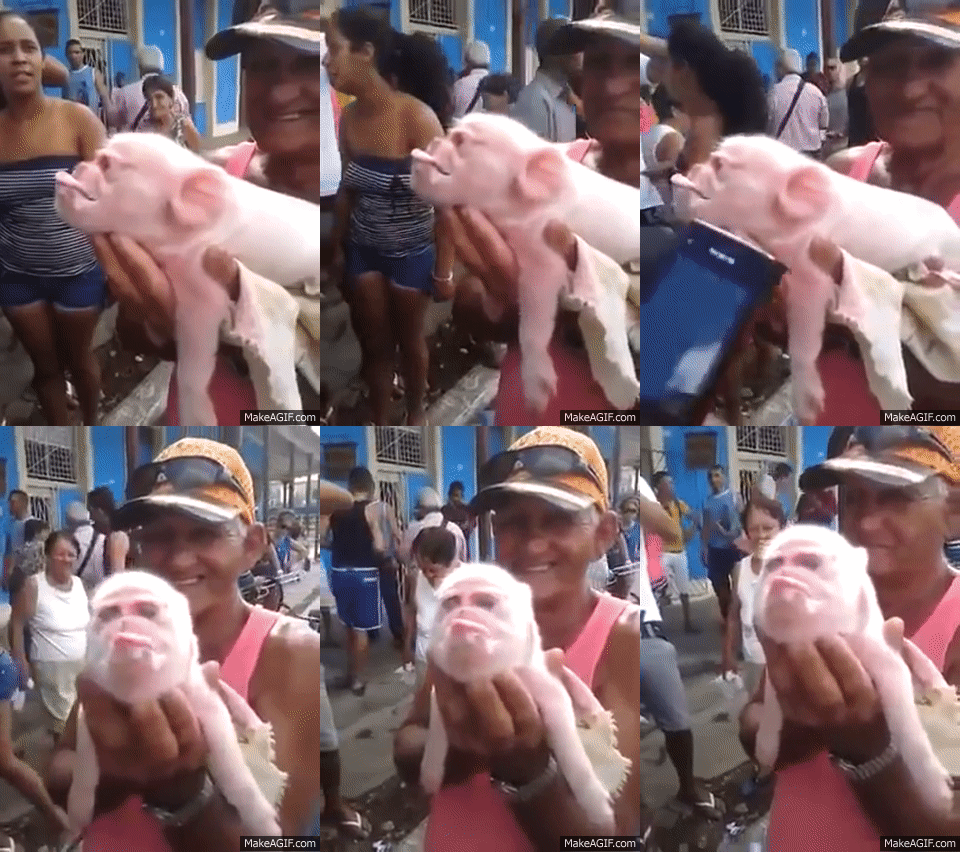 Pig-human hybrids
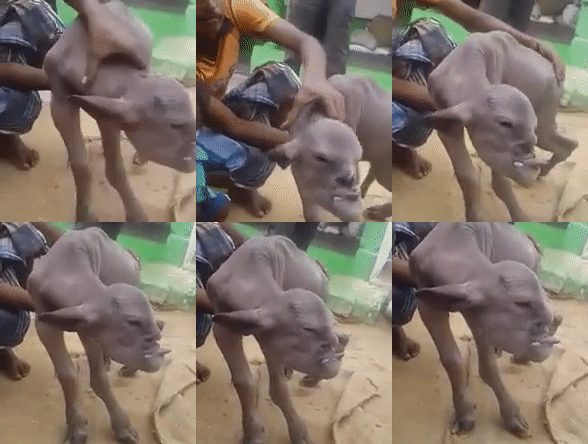 Cow-human hybrids
 Sheep-human hybrids
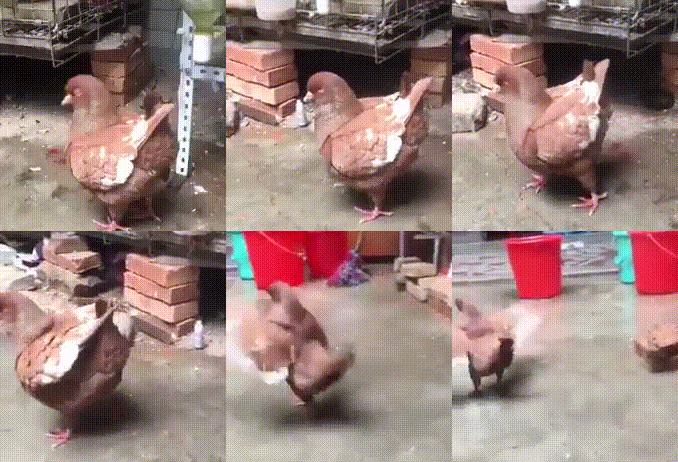 Chicken-pigeon hybrids
- Ultimately, the interaction of gametes at the time of fertilization, and the subsequent interplay of genes (derived from two different types of parents) during the course of a hybrid’s development cannot be predicted by any known laws because the interaction is between a multitude of extremely complex chemical entities that each have an effect on others. It is for this reason that the degree of similarity perceived between two organisms is no sure indicator of their crossability.
- Another suggestive fact, probably known to the reader, is the frequent use of pigs in the surgical treatment of human beings. Pig heart valves are used to replace those of human coronary patients. Pig skin is used in the treatment of human burn victims. Serious efforts are now underway to transplant kidneys and other organs from pigs into human beings. Why are pigs suited for such purposes? Why not goats, dogs, or bears — animals that, in terms of taxonomic classification, are no more distantly related to human beings than pigs? (In subsequent sections, these issues are considered in detail.)
- God did not place pigs and humans in different taxonomic orders. Taxonomists did. A great deal of evidence (read a discussion of this topic) exists to suggest that taxonomists are, in no way, infallible. Our ideas concerning the proper categorization of animals are shaped by bias and tradition to such an extent that it would be rash to reject, solely on taxonomic grounds, the feasibility of such a cross.
- The general examination of the process of evolution as a whole (as presented elsewhere on this site) strongly suggests that most forms of life are of hybrid origin. Why should humans be any different?
- It might seem unlikely that a pig and a chimpanzee would choose to mate, but their behavior patterns and reproductive anatomy do, in fact, make them compatible (this topic is considered in detail in a subsequent section). It is, of course, a well-established fact that animals sometimes attempt to mate with individuals that are unlike themselves, even in a natural setting, and that many of these crosses successfully produce hybrid offspring.
- Accepted theory, which assumes that humans have been gradually shaped by natural selection for traits favorable to reproduction, does not begin to account for the relative infertility of human beings in comparison with nonhuman primates and other types of animals (see previous section). How would natural selection ever produce abnormal, dysfunctional spermatozoa? On the other hand, the idea that humans are descended from a hybrid cross — especially a relatively distant cross — provides a clear explanation for Homo’s puzzling and persistent fertility problems.
- If we supposed standard theory to be correct, it would seem most peculiar that pigs and humans share features that distinguish human beings from chimpanzees, while pigs and chimpanzees do not. Conventional theory (which assumes that pigs are equally as far removed from humans as from chimpanzees) says that pigs and chimpanzees would share about as many such traits as would pigs and humans. And yet, I have never been able to identify any such trait—despite assiduous investigation. The actual finding is that traits distinguishing chimpanzees from humans consistently link pigs with humans alone. It will be difficult to account in terms of natural selection for this fact. For each such feature, we will have to come up with a separate ad hoc argument, explaining how the feature has helped both pigs and humans to survive and reproduce. On the other hand, a single, simple assumption (that modern humans, or earlier hominids that gave rise to modern humans, arose from a cross between pig and chimpanzee) will account for all of these features at a single stroke.
|
A friend pointed me to your site during a conversation the other day and I spent a while reading the site. It seems more plausible to me than gradualism for what we observe in human, chimp, and pig biological structures and their abnormal distribution across species, as you pointed out. In our conversation we concluded that with pigs and chimpanzees, there would have only had to have been one successful offspring that was still fertile with chimpanzees, with the child having multiple surviving, fertile offspring. We guessed that because of simian group dynamics it would probably have to be a female offspring, a male that was unusual would be unlikely to have mating opportunities with the rest of their group but a strange female would still be acceptable to at least some of the male members of the group. And it would only have to happen once.
—A reader’s comment
|
For my own part, curiosity has carried me away from my old idea of reality. I no longer know what to believe. Is it possible that so many biologists might be wrong about the nature of human origins? Is it possible for a pig to hybridize with a chimpanzee? I have no way of knowing at present, but I have no logical or evidential basis for rejecting the idea. Before dismissing such a notion, I would want to be sure on some logical, evidentiary basis that I actually should dismiss it. The ramifications of any misconception on this point seem immense. As Huxley put it long ago, “The question of questions for mankind — the problem which underlies all others, and is more deeply interesting than any other — is the ascertainment of the place which Man occupies in nature.”
Are we simply another type of primate, like the chimpanzee or the baboon? Or are we a complex melange, an alloy of two very distinct forms of life? These are questions that can only be resolved by examining the evidence. I invite the reader to consider these two possibilities as simple hypotheses, to consider the data coldly, and then to determine which of the two is more consistent with available evidence.
By the same author: Handbook of Avian Hybrids of the World, Oxford University Press (2006).
A comment from the website Skeptophilia:
If you read the ENTIRE website written by McCarthy, you will find that there are mountains of evidence going back centuries to support “stabilization processes” being the true origin of species and that Darwin’s and the Neo-Darwinian view that natural selection alone could account for the evolution of species is not supported by the fossil record or by common sense when compared to the changes brought about by the enormous chromosomal changes inherent ONLY through hybridization.
Be a true skeptic. Read the WHOLE website and challenge everything you “know” about evolution.
Get over the chimp-pig hybrid thing for now, because you haven't even begun to open your mind to that. This isn't quack science. It’s a revolutionary shift in understanding evolution itself — not an understatement.
His evidence doesn't stop at sperm abnormalities in human beings — to claim that indicates you didn't even read the entire article, let alone understand it. There is a mountain of evidence and observations that you are leaving out.
The origin of ALL species is McCarthy’s goal here, and he knocks it out of the park.
Hi Gene — I read the article you included — very good come-back from those you quoted — I thoroughly agree with them both. Every new theory meets exactly this same reaction — you are upsetting the apple-cart - they can't handle it - stay cool, plenty of people LOVE new ideas. The biggest single problem is that of status quo — those whose positions are threatened by anything new that THEY did not think of. It is a threat to their smug lives, and the definition of who the 'experts' are — you make them look like idiots, they are not going to support you. The Internet is giving us all so much education we would have never happened upon otherwise. Love it. Remember you have many supporters now. Bye for now.
A weird, crazy, and compelling theory of human evolution: we're descended from a primate+pig hybrid. http://t.co/CpBGCyZXu1 by @bengoertzel
— Andron Ocean (@AndronOcean) September 28, 2013
Wow. Very interesting theory that humans didn't just evolve from apes, but hybridization w/ pigs and backcrossing http://t.co/ORDveqIokE
— Ryan (@QuasarLazer) September 24, 2013
http://t.co/N2fclvuU6v more on the astounding chimp-pig hybrid. The evidence appears overwhelming we're partly porcine... #weird
— jrms (@jrms) August 4, 2013
@macroevo - I think I just became kosher. http://t.co/BebXbavhy7
— Bryan Goldstein (@brysgo) September 13, 2013