Tasmanian Tiger
Thylacine
Online Biology Dictionary

|
|
|
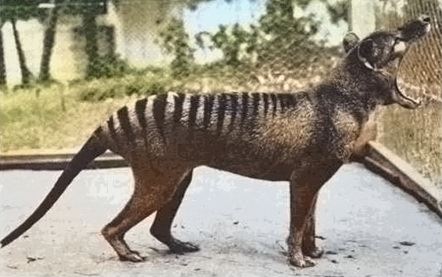
Thylacine: These animals had a huge gape and a powerful bite. In one account, a cornered thylacine, fighting a dog, bit off the top of its opponent's skull with a single snap (see: The Wild Animals of Australasia, Le Souef and Burrell, 1926).
|
|
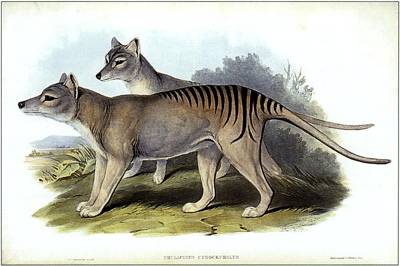
| Another picture, showing coloration. |
The Tasmanian tiger (Thylacinus cynocephalus), also known as the thylacine or Tasmanian wolf, was a large carnivorous marsupial similar in appearance to a dog, but with catlike striping on its tail and hindquarters. Now extinct, it survived into recent times.
At the time of the European colonization of Australia, the thylacine survived only on the island of Tasmania, thus its name. It did, however, once exist in Australia and New Guinea, as shown by fossils and the rock art of the indigenous peoples.
Extensively hunted by farmers, the Tasmanian tiger was already rare in the wild by 1900, and it was declared extinct in 1936 when the last captive animal died. Nevertheless, numerous unverified sightings are reported even today.
|
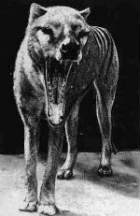
Of course, as a marsupial, the thylacine was no more a true tiger, than it was a true wolf. Rather it was a pouched mammal like a kangaroo. True, it did have many doglike features. But it had climbing and leaping abilities far beyond those of any dog. In one old account, an agitated pet thylacine is described as jumping up into the rafters of a cabin and running about there like a cat. It also differed from both dogs and cats in the huge size of its mouth (see image).
The thylacine was one of only two marsupials to have a pouch in both sexes (the other being the South American water opossum, or yapok (Chironectes minimus). In the male, the pouch served in protecting the external genitalia.
Since high-quality thylacine DNA has been recovered from museum specimens, there has been discussion of the possibility of resurrecting these animals. But such efforts are still a long way from being a reality. There have also been repeated reports of alleged sightings of this animal in the sparsely populated regions of southern Tasmania. Some believe thylacines will yet be discovered there alive. Let's hope so.
|
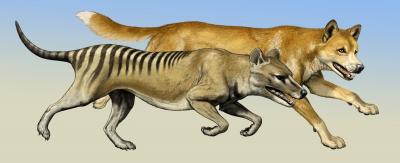
| Thylacine compared to a dingo. Credit: Carl Buell |