Prophase
Stages of Mitosis

|
EUGENE M. MCCARTHY, PHD GENETICS
 Chromosomes (red) being dragged toward the metaphase plate. Image: Ted Salmon, NIH.
 |
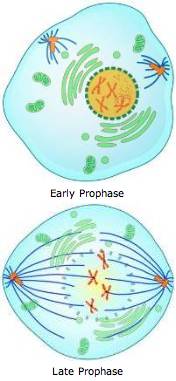
During interphase, the chromosomes, which are made of heterochromatin and euchromatin, are contained in the nucleus (see video above and upper picture at right).
But as mitosis begins, the nuclear envelope starts to break up and disappear. Each chromosome has replicated during interphase and is therefore composed of two sister chromatids containing identical genetic information.
Early during prophase, the first stage of mitosis, the chromosomes become visible with a light microscope as they condense (that is, as they shorten, coil, and thicken). Also, a spindle apparatus (blue strands in the upper two figures at left) begins to extend outward from each of the two centrosomes. These starlike configurations, composed of radiating microtubules, are also known as asters — Greek for stars — (see photomicrograph of asters >>).
After the nuclear envelope has disappeared, proteins bind to the centromeres to make the kinetochores. Microtubules attach at the kinetochores and the chromosomes begin to move.
Pronunciation of prophase:
It's "PROH-faze," not "PROP-faze."
Mitosis happens everywhere, even in my toe,
Meiosis only happens in my OH!
 Flemming
|
| Note: No tetrads form during mitosis. |
| Prometaphase. Some teachers like to distinguish a fifth stage of mitosis called prometaphase, which corresponds to that portion of mitosis occurring after the disappearance of the nuclear envelope, but before arrival of the chromosomes at the metaphase plate. | The spindle apparatus >> |
| Centrosomes >> | |
| Kinetochores>> | |
| DNA replication >> | |
| Sister chromatids >> | |
| Nuclear envelope >> |
Most shared on Macroevolution.net:
Human Origins: Are we hybrids?
On the Origins of New Forms of Life
Mammalian Hybrids
Cat-rabbit Hybrids: Fact or fiction?
Famous Biologists
Dog-cow Hybrids
Georges Cuvier: A Biography
Prothero: A Rebuttal
Branches of Biology
Dog-fox Hybrids