Interesting facts about giraffes
Online Biology Dictionary

EUGENE M. MCCARTHY, PHD
 Enlarge
Many interesting facts about giraffes aren't commonly known. For example, a giraffe has such a long tongue that it can lick almost any part of its face.
The tongue and lips are tough and virtually impervious to thorns, which allows them to eat many foods that other animals can't. Likewise, the hide is so thick that it was formerly used to cover shields. Even their coat, which has a peculiar smell, provides these creatures with an unusual amount of protection— scientific analysis has shown it's full of antibiotic secretions and parasite repellents.
The giraffe is the largest ruminant, and the tallest terrestrial animal (really the tallest animal period, since marine animals are normally measured in terms of length instead of height).

 Enlarge
How tall is a giraffe? An average male giraffe's height is 5.3 meters (17.4 feet), an average female's, 4.3 meters (14.1 feet). A giraffe's neck weighs about 270 kilograms (600 pounds) and is about 1.8 meters (6 feet) long, and its legs are as long as its neck.
Other interesting facts about giraffes
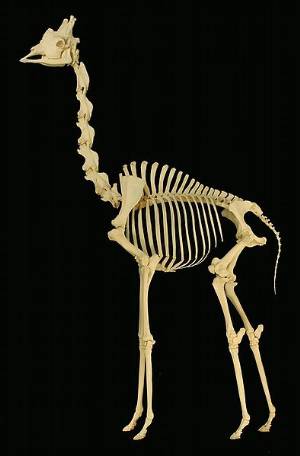
One strange fact thing giraffes is that even though they have such long necks, they still have the same number of bones in their necks as do most other mammals (seven). But these bones, known as cervical vertebrae, are far longer than those of other mammals (see picture at right).
Though a giraffe's heart is huge — it's 0.6 meters (2 feet) long and weighs about 11 kilograms (25 pounds) — the great height of a giraffe still makes it hard for the heart to pump blood to the brain. This problem is overcome by a series of one-way valves that force blood toward the head. Giraffes are also able to put plenty of oxygen into their blood because they have tremendous lungs — they can hold 55 liters (12 gallons) of air.
The fact that a giraffe has perhaps the keenest vision of any African big game animal gives it, together with its height, the greatest range of vision of any terrestrial creature. Like a camel, a giraffe can stock up on water and then go without drinking for long periods of time. They can also run for long distances, as fast — or even faster — than a horse.
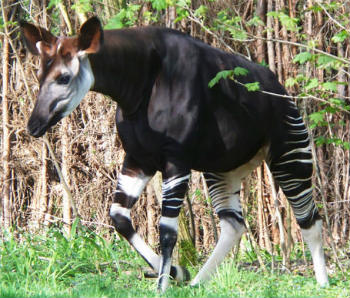 Okapi: A zebra-giraffe hybrid?
One of the most surprising giraffe facts is that they sleep far less than most other mammals, typically less then two hours a day (on average, 1.9 hours). Most giraffes have two to four horns, but some have five, the fifth, sometimes just a knob, being located in the center of the forehead.
A final interesting fact about giraffes is that there are a variety of very distinct types, which were formerly treated as different species. These were all lumped when it was discovered that they hybridize in the wild. In fact, the okapi might be a giraffe-zebra hybrid.