Dog-goat Hybrids
Mammalian Hybrids
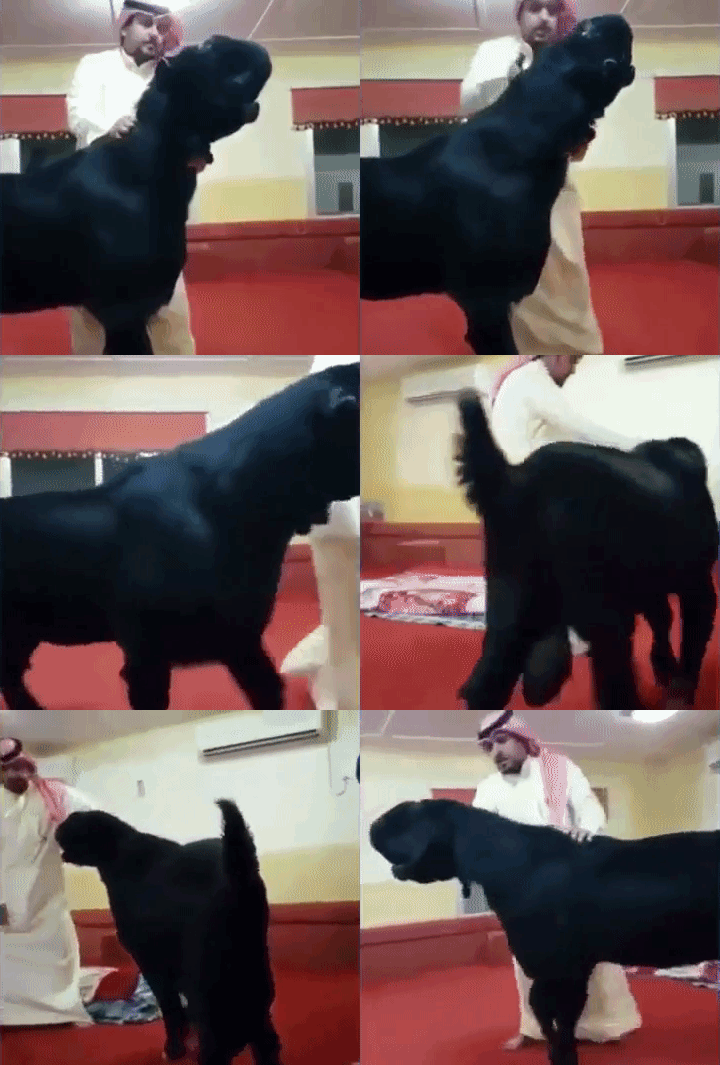 Above: An excerpt from a YouTube video entitled "Dog-Goat Hybrid Video - REAL." However, the video is accompanied by no details and it is unclear who the person shown in the video might be. Such animals have been described as a breed (the Damascus goat, aka the Aleppo, Halep, Damascene, Bakra, Shami, or Chami). It seems they were first produced in Syria, given that Damascus and Aleppo (also known as Halep) are cities in that country. But did their origin involve genetic input from dogs via hybridization? Various reports about such hybrids (quoted below) do exist.
|
A diligent scholar is like a bee who takes honey from many different flowers and stores it in his hive.
—John Amos Comenius
|
A video of a goat nursing a puppy.
A video of a dog nursing a kid.
That male dogs will mount female goats is documented on YouTube (see, for example, the video at right). The reverse mating, billy goat × bitch, also happens, but seemingly with less frequency (the Mexican report quoted below describes a hybrid obtained with the cross in this direction). Goats also sometimes nurse puppies (see video at right), as do dogs, goats (lowermost video). Such fostering of young animals can result in imprinting, the tendency of an animal, when sexually mature, to seek mates of the same kind as its foster parent.
Reports about dog-goat hybrids are rarer than those for dog-cows. Perhaps the difference is due to the fact that cattle are far more common in developed countries than are goats? Cattle in the U.S. outnumber goats by a factor of about 30 to 1. The frequency with which dog-goats are reported seems to be about the same as that for dog-sheep hybrids.
The following report (originally published in the Las Vegas, New Mexico Optic) appeared in the Albuquerque, New Mexico Daily Citizen (Feb. 20, 1902, p. 5, col. 2):
HALF DOG, HALF GOAT
Strange Combination Animal Appears in Las Vegas
Half dog and half goat. You could swear to that. So could anyone who saw the thing on the west side streets this morning as it limped, goat fashion, behind a rural Mexican’s outfit.The creature was a wonder for combination. It had a goat’s body, but a dog’s head. The head had a dog’s eyes and a dog’s ears, but under the ears, from a lank goat throat, fell long strands of angora goat silk of unmistakable quality. The feet were those of neither dog nor goat. They were like the feet of a sheep. About the hocks fell long shaggy bunches of fine soft silk and larger, shaggier strands of a finer texture adorned the body and the hind legs. The tail was a white fluffed stump, more like no tail at all than anything else. The dog-goat might as well have been born a rabbit so far as caudal appendage is concerned. Except for the head, not a person alive would have guessed that this goat was a dog. A number of dogs came up to make friends, but they invariably decided that the acquaintance would not be acceptable. The poor beast evidently did not understand one word of dog talk anyway. An accident to its left hip caused it to limp.
The following report appeared in the Indianapolis Journal (Dec. 13, 1903, p. 4):
HARTFORD CITY MAN HAS CURIOUS HYBRID
Cross of Dog and Goat That Excites the Interest of Stockmen All over the Country
IS BRIGHT AND PRETTY
HARTFORD CITY, Ind., Dec. 12—A dog covered with the silky fleece of an Angora goat, from which it differs only in color, is owned by Hosh Mills, a bartender of this city [i.e., Hartford City, Indiana]. The little animal is a most beautiful creature and has many unusual characteristics.
The mother of the dog is an Irish setter, and the sire is said to be one of the most beautiful specimens of the goat family to be found. A massive head of the St. Bernard adorns a short, thick body not over eighteen inches long, and its height does not exceed six inches. Its legs are short and the feet unusually large, while the stubby tail points skyward. The little freak is one of a litter of ten pups, and the remainder possessed no features similar to this one. It seemed more “pert” from the start than its little brothers and sisters, and the mother seemed to take special pride in caressing it in preference to them, especially when anyone is around.
The cross in breeding is thought to be one of the most remarkable ever heard of in this country. The hybrid is covered with a fleece that is silky in texture and so thick that one is unable to pull it apart far enough to see the skin.
Mills prizes the animal very highly, and, though numerous offers have been made for it, he has refused to part with it. So far as known this is the only cross of this kind on record, and stockmen all over the country have become interested in the matter.
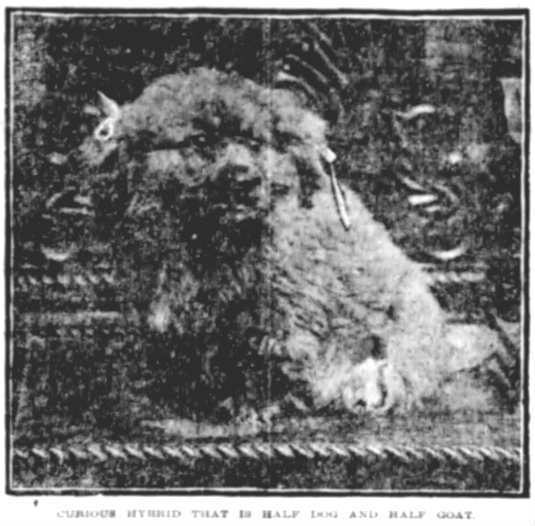 The image above accompanied the 1903 Indianapolis Journal article quoted aove. Like all attempts to reproduce photographs in newspapers of that era, the picture is of very low quality. No obvious traits of a goat are visible.
Another alleged dog-goat hybrid was reported in a news story that appeared in the Gazette de France on May 6, 1768. The Gazette, when it was discontinued in 1915, was the oldest newspaper in France. The same article was reproduced in the scholarly journal Mémoires de l'Académie de Prusse. The reported event allegedly occurred in the village of Mussey, which has since been merged with Val-d'Ornain, a commune about 25 miles north of Joinville in northeastern France. An English translation of the text reads as follows: “We have obtained from Joinville the following particulars, which are
‡ The French term used here ("chien courant") seems to be equivalent to the English "scent hound," that is, a tracking breed such as a basset or blood hound.
Another eighteenth-century report about a dog-goat hybrid appeared in the Gazeta de Mexico (Aug. 5, 1788, p. 1). It says that on June 19, 1788,
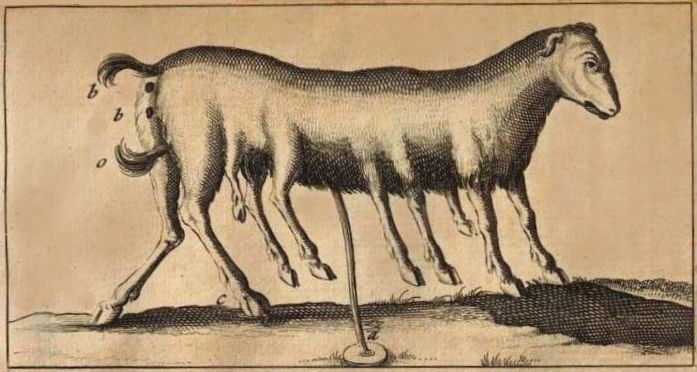 A drawing of the alleged goat-dog hybrid described on pages 197-198 of the June 14, 1683, issue of Journal des Sçavans. Note that the rear foot labeled C is the one that the report says was shaped like a dog paw.
A very early, but exceptionally interesting report about a dog-goat hybrid appeared on pages 197-198 of the June 14, 1683, issue of Journal des Sçavans, the first academic journal published in Europe. The report, translated by E. M. McCarthy (original French), reads as follows:
An extract from a letter from Rumilly, in Savoy dated last May the 19th, to the editor of the Journal, written by Pierre Merindol, Professor of Philosophy. [Today, Rumilly is a commune of some 12,000 inhabitants in the Upper Savoy department in the Auvergne-Rhône-Alpes region of France.]
On the 13th of this month [May 1683], a woman in a village three-quarters of a league from here, delivered a monstrous kid from a nanny goat of which I send you a drawing. The long umbilical cord, labeled A in the drawing, appeared first, and this woman, whom I questioned myself, ripped it out in an attempt to help with delivery, but in doing so actually killed the fetus. The end of the cord was filled with a matter that inflated it like a balloon. The kid had the muzzle of a dog, as well as one foot of a dog (labeled C in the drawing). The foot on the left, corresponding to this dog paw, was like that of a goat, but reversed, as if to walk backward. These two legs were accompanied by eight others, all but two of which were shorter than the rest. The rest of the body was for the most part no different from that of other lambs, except in that it was a little larger, and the hair was more like that of a dog than is an ordinary lamb’s [Here, Merindol goes on to discuss the fact, as can be seen in the drawing above, that this animal had two tails and multiple orifices between them. He also mentions that he thought it would have lived if it had been properly delivered.].
Another, short report about an ostensible dog-goat hybrid appeared in the February 22, 1910, issue of the Viennese newspaper Welt Blatt:
Similar crosses:
Dog x cow,
Dog x sheep.
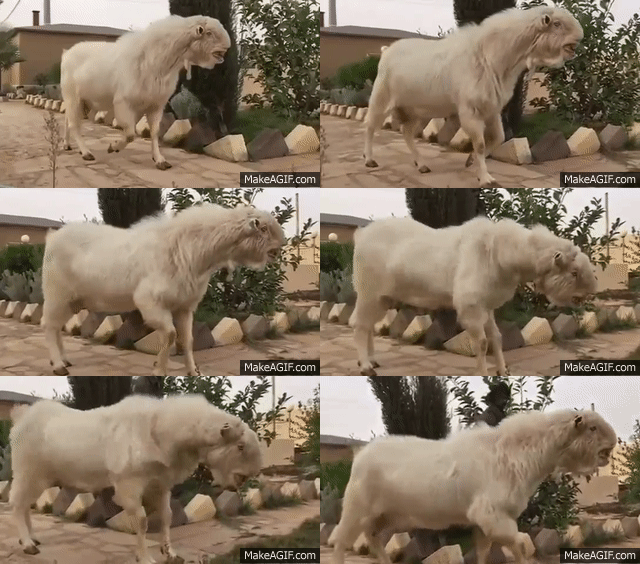
A list of dog crosses
The following is a list of reported dog crosses discussed on this site. Some of these crosses are much better documented than others (as indicated by the reliability arrow). Moreover, some are extremely disparate, and so must be taken with a large grain of salt. But all have been reported at least once.
 Sheep-pig hybrids?

|
By the same author: Handbook of Avian Hybrids of the World, Oxford University Press (2006).