Snake-human Hybrids
Mammalian Hybrids
|
If a woman gives birth to a child with a serpent’s head, there will be famine in the land.
—A Mesopotamian birth omen‡
|
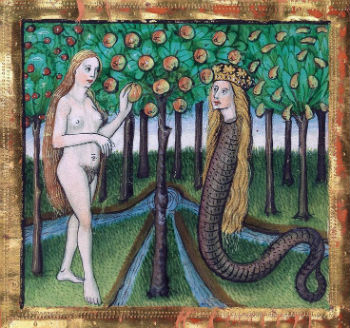 Enlarge
I list every cross that’s reported, at least those reports that purport to be in earnest, not because I think every reported hybrid is real, but because I use the name of a cross as a heading for a page that serves as a repository for all the information of any kind that I’ve collected about that cross. Somewhat surprisingly, there are quite a few serious reports about snake-human hybrids.
One such report, about what, if real, would be a pair of extremely odd hybrids, recalls such things as the Garden of Eden, Milton’s Hell, and tales of the Egyptian gods. It appeared in the Cleveland, Ohio, Morning Leader (Aug. 30, 1864, p. 1, col. 1):
HORRIBLE MONSTROSITY
A woman delivers twins with the heads of serpents
[From the Dubuque Herald]Wonders never cease! and the greatest ever heard of in these modern times has just come to our knowledge from entirely reliable authority. It fully disproves the wisdom of Solomon when he proclaimed that “there is nothing new under the sun.” The facts related to us are:
About two weeks ago the wife of a market gardener, residing at Eagle Point, in this city, gave birth to twins which, instead of being provided with the head and features of the “human form divine” had each the head and neck of a snake! Besides the head and shoulders the children were of natural and comely form—from the shoulders up they presented the horrible shape and characteristics of the serpent! Immediately after the birth a consultation of physicians was held, at which it was very properly decided to bleed the monsters to death, which was, accordingly done. What disposition was made of the bodies we have not yet learned.
The cause assigned for the lusus naturae is that several months ago, shortly after the woman became enciente, her husband playfully threw a snake’s head into her face, which so frightened her that the foetus assumed the horrible shape into which they were brought into the world.
Article continues below
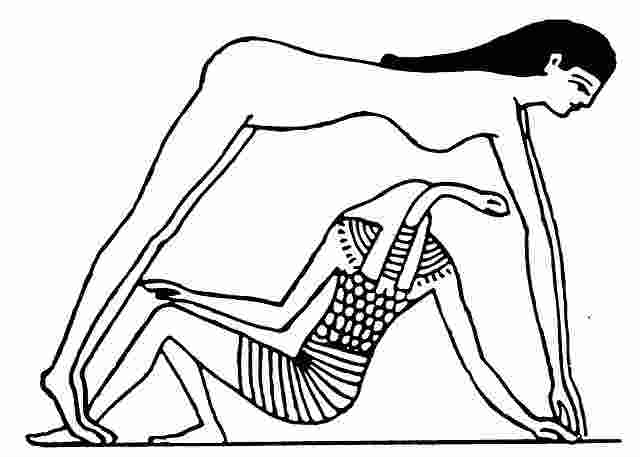 The sky goddess Nut and the snake-headed god Geb
Image: E. A. Wallis Budge, The Gods of the Egyptians.
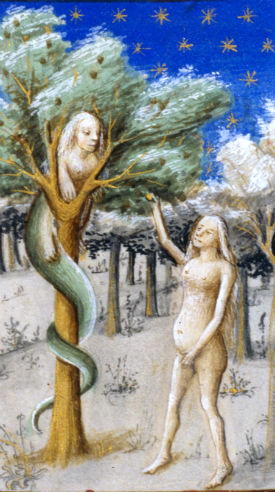 Satan deceives Eve (Le Miroir de Humaine Salvation, c. 1455).
In another account we find a troubled physician tussling with a vicious serpentine delivery. The report appeared in the Pulaski, Tennessee, Citizen (Jun. 19, 1868, p. 3, col. 2):
In April 1894, in Brenham County, Texas, the same locale where that same month there had been reports of a fish-human hybrid, a certain Emma Blivens reportedly gave birth to an offspring with the lower extremities of a human body, but the foreparts of a snake. According to the Granada, Mississippi, Sentinel (Apr. 21, 1894, p. 8),
A separate account of an alleged snake child appeared in the St. John’s, Newfoundland, Public Ledger (Jul. 11, 1871, p. 1, cols. 3 & 4). The creature described was reportedly born on Cape Cod. So the story originally appeared in the Boston Herald, undersigned by a physician, Dr. J. H. Hanford of Reading, Massachusetts:
A SNAKE CHILD
MORE SERPENT THAN HUMAN
WONDERFUL FREAK OF NATURE
(From the Boston Herald, Jan. 4.)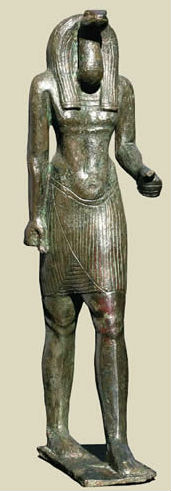 The snake-headed god Nehebkau
During a recent visit to Cape Cod, the writer was made acquainted with a remarkable freak of nature, one illustrating the results of certain influences exerted before birth, in the person of a male child, known as the “snake child.” This is the son of Mr.___, of Harwick, a little more than three months old, and regarded as “more snake than human.” During the term of pregnancy, which was attended with various peculiar sensations, the mother was in an unusual frame of mind, and gratified a kind of monomania for killing snakes, never allowing an opportunity for an encounter with them to pass unimproved. On one occasion she fought two and a half hours with three adders in an arbor, at last conquering and killing them. On another occasion she came suddenly upon a large black snake, the ‘size of her wrist,’ which raised his head very high and ‘showed fight.’ True to her strange impulse, she commenced the attack and was the conqueror, instead of screaming, like most females, and leaving the spot in haste, though his snakeship presented a formidable, if not a frightful, appearance. This monstrosity, which weighed 13 lbs. at birth has the more general appearance of a human being in the outlines of the body, than in the head and limbs, though the shoulder blade is wanting, or very unlike the natural one. The head is very large having, at birth, the appearance, with the general expression of the face, especially the upper part, of a child at the age of two years. It rises high, the line of the front and back being nearly parallel, though inclining upward and forward with an arched appearance. The forehead is high, and projects considerably over the eyes. The ears, which are large, are located very far forward, and about one inch lower than usual, or about on a direct line with the chin. The eyes are large, snakish, elongated, protruding, and much in motion. The lower jaw has an unusual appearance, appearing as if double, while the roof of the mouth is narrow and deep. The mouth is open, save when nursing the bottle. The tongue as thick as some two or three ordinary ones, and is very smooth. The lips remain in one position, about a half inch in a straight line, above and below, with a gradual curve toward the angles. The nose is rounded at the tip, much depressed at the base, and the nostrils much distended, the whole looking snakish. Instead of the usual soft place in the top of the skull, there are two, one in the forehead, and the other far back, the skull between these more nearly resembling the back of a turtle than a child’s head. There are two bony projections in the forehead, over the eyes, like prospective horns, while between these and the eyes are deep cavities. The face, which is long and large, with the exception of the mouth and chin.—is proportionately small—has a mature expression, rather snakish, the chin being usually pointed. The feet and hands are the most remarkable, evidently presenting the deformity in its worst aspects. Both are unusually arched, and in other respects peculiar. The large toe is short, like a thumb, inclining downward and toward the hollow of the foot, with the small one also. The remaining ones, which are destitute of the usual joints, are enclosed in a kind of sheath, a thick skin and some flesh, all terminating at the ends in one broad and large n ail, inclining downward like a half tube. This nail, and indeed those of both the hands and feet, have a decidedly snakish look. The hands are still more peculiar, rather more arched than the feet. The bones of the hand are more distant, relatively, than those of the feet, with a deep cavity between, rather irregular. One of the toe bones is disconnected with those of the foot, passing instead, downward toward the hollow of the foot, there floating with no attachment. Others seem to be deficient in the usual connection in this respect. The palm is very deep, corresponding with the unusual arch both of the hand and finger sheath. The thumb and the small finger incline toward the palm, and are rather short, resembling the general construction of the corresponding members of the foot, though the small finger is more connected with the others by an arrangement resembling that of the web foot. The remaining three are almost in a form of a triangle, joining at the ends in one general broad and large nail. Extending down the sides of the fingers, almost enclosing them. I could detect no joints in these fingers, only the one joining them to the hand. The little fellow seemed unwilling to have his hand held long enough to have them carefully examined, making one feel that he was handling a snake. The general appearance of the hand, the form of enclosed fingers, the form of the nails, etc., are wonderfully suggestive of the snake. Indeed, one can scarcely look at this unique creature, observe the almost constant motion of the hands, feet, tongue, the turning of the head from side to side, and see the snakish aspect, without feeling a kind of shuddering, a wish to withdraw from his presence, so snakish is he in his appearance and movements.
J. H. Hanford, M. D., Reading Mass.
Article continues below
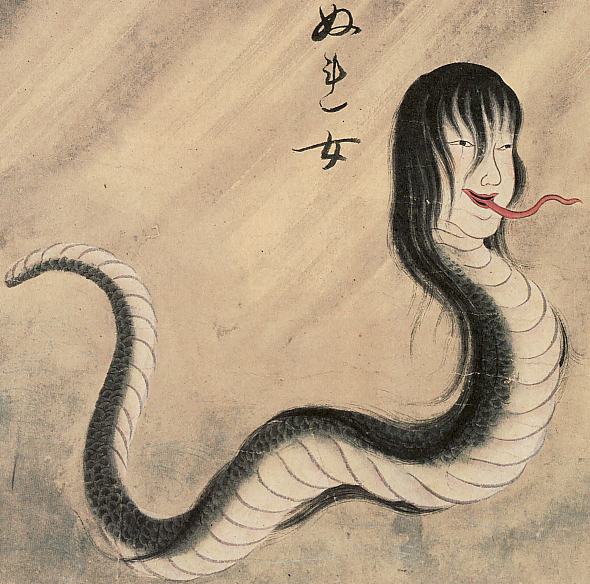 A nure-onna (From the Hyakkai-Zukan, 1737; Artist: Sawaki Sūshi, 1707-1772). In Japanese folklore, a nure-onna (in English, “wet woman”) is a yōkai with the head of a woman and the body of a snake.
Another case of reported snake-baby appeared in the Memphis, Tennessee, Public Ledger (May 8, 1867, p. 2, col. 3):
WONDERFUL BABY
A Being Half Human, Half Rattlesnake
We learned yesterday from a gentleman of undoubted veracity, and who is acquainted with the facts we are about to relate, of one of the most wonderful freaks of nature on record, which occurred in West Tennessee.
The incident happened in one of the most respectable families in that section, and its features are so revolting that very few would readily believe that such a thing could possibly occur. Strange as it may seem, however, we are assured of its authenticity, and lay it before the public as it came to us.
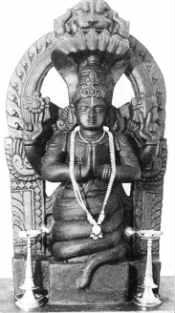 A Hindu snake-human deity
This startling lusus naturae is accounted for by the fact that the mother sometime previous to her confinement, narrowly escaped the fangs of a huge rattlesnake, and was so terrified by the occurrence that she became subject to fits.
We are not permitted to mention any names in connection with this remarkable occurrence, the delicacy of the subject warranting us in omitting them.
Franci (Continuator temporis quinquennalis, 1599, p. 122) reports that on March 4, 1595, a woman at Bacharach (which now lies in Germany) gave birth to a living offspring that in its foreparts was like an ordinary child, but in its hind parts, like a snake.
Another snake-human hybrid slithered into the Alpena, Michigan, Argus (Jul. 19, 1893, p. 1, col. 7). This report ran in many U.S. papers that summer:
The next report is copied from the Johnson City, Tennessee, Comet (May 2, 1885, p. 2, col. 3). The original source of the story was the Knoxville, Tennessee, Journal.
A Monstrosity
The freak of nature is accounted for by the friends of the woman in the statement that she attended the last circus and became frightened at a large snake. The corpse was buried yesterday and the mother is reported as getting along very well.—Knoxville Journal,
Another such report appeared in the Westminster, Maryland, Democratic Advocate (Aug. 25, 1900, p. 4, col. 1):
Child Like a Snake
The next report, originating in the town of Lathrop in northwestern Missouri, appeared in the Rock Island, Illinois, Daily Argus (Oct. 20, 1887, p. 2):
 Two nagas (Halebidu, India).
Delivered of Two Monstrosities
Article continues below
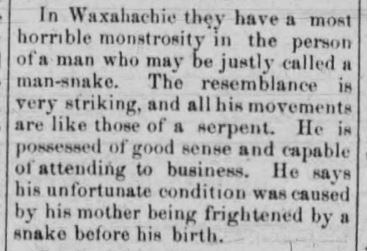 A notice in the Marshall, Texas, Messenger (Jun. 18, 1880, p. 2; ||yxcmnlha).
From the Tehama, California, Tocsin (Mar. 20 1880, p. 4, col. 1):
A SNAKE CHILD
The Missing Link Found at Last
The following news story, about the death of a woman with snakelike traits, is taken from the Dodge City, Kansas, Times (Feb. 20, 1890, p. 1, col. 4):
A snake-human birth in Colorado >>
Women birthing snakes
The Swiss physician Gaspard Bauhin (1560-1624), a resident of Basel, reported that a certain Anna Toperim, living in that city, gave birth first to a male child and then to two snakes "an ell long, and as thick as a childs arm" (Culpeper, 1676, p. 152). Ancient Roman writers, too, spoke of women giving birth to snakes, as if of historical events. Thus, Pliny the Elder (The Natural History, 7.3) writes that “At the commencement of the Marsian war, a female slave was delivered of a serpent” and the historian Tacitus (Annals 14.12) claims that in the reign of Nero another woman birthed a snake. Phlegon of Tralles, a Greek writer and freedman of the emperor Hadrian, records another such birth (On Marvels, 24):
Herodotus
A relevant excerpt from Herodotus (The Histories, 4.8-9):
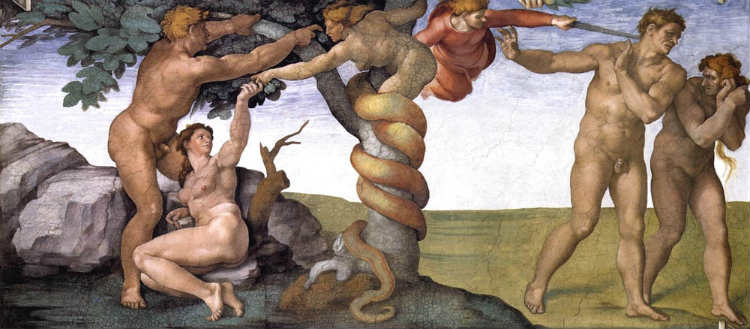 The Fall of Man, Michelangelo (depicting Satan as a snake-human hybrid).
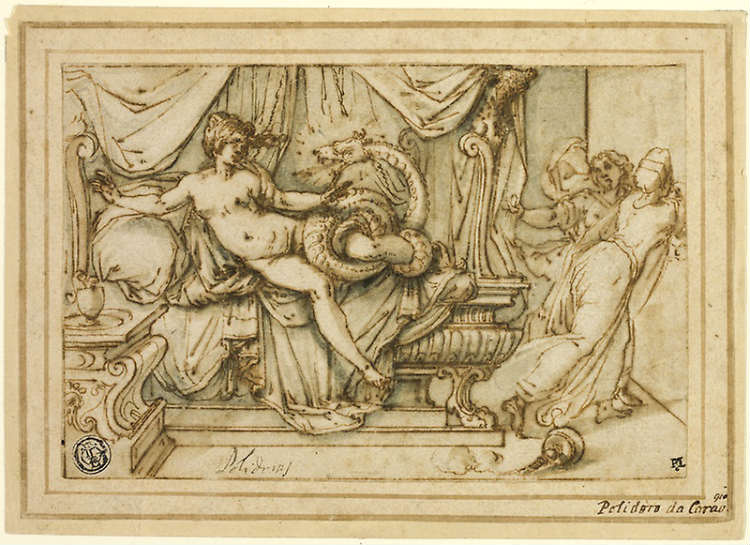 Olympias, Mother of Alexander, Visited by Zeus in the Guise of a Serpent. Attributed to Andrea Boscoli
Italian, c. 1560-1608. In ancient times, it was said that Alexander the Great was the son of Zeus who, in the guise of a serpent, had lain with Alexander’s mother Olympias (see Plutarch’s Life of Alexander).
Olympias, Mother of Alexander, Visited by Zeus in the Guise of a Serpent. Attributed to Andrea Boscoli
Italian, c. 1560-1608. In ancient times, it was said that Alexander the Great was the son of Zeus who, in the guise of a serpent, had lain with Alexander’s mother Olympias (see Plutarch’s Life of Alexander).
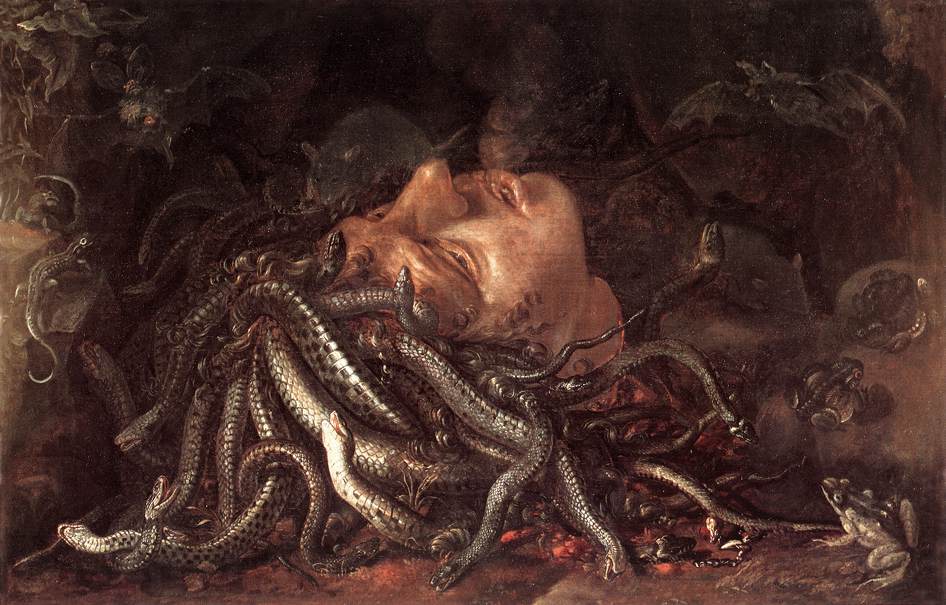 Medusa, by a Flemish artist. Oil on wood, 16th century.
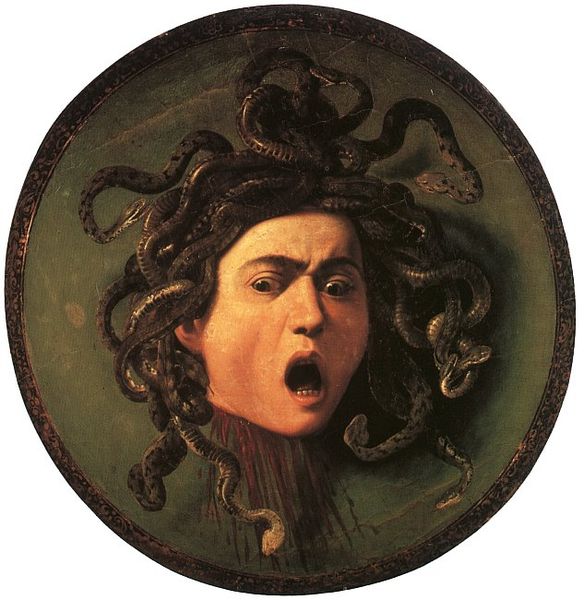 Medusa, by Caravaggio.
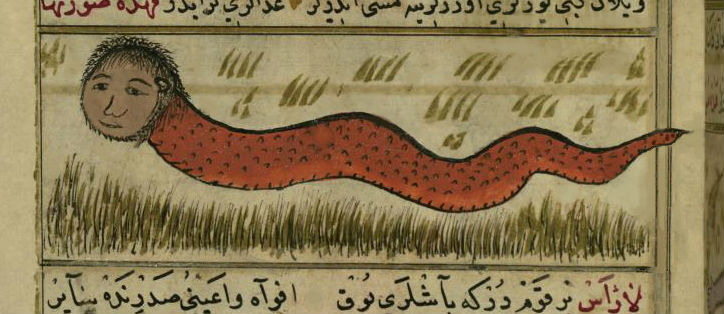 A snake human hybrid, as pictured in an 18th century Ottoman copy of a 13th century bestiary by Zakariya al-Qazwini (Walters MS; acc#: W.659.145A).
By the same author: Handbook of Avian Hybrids of the World, Oxford University Press (2006).