Cro-Magnon Skull
Online Biology Dictionary

|
EUGENE M. MCCARTHY, PHD
|
|
|
|
|
Cro-Magnon skull |
|
|
Louis Lartet (1840-1899) |
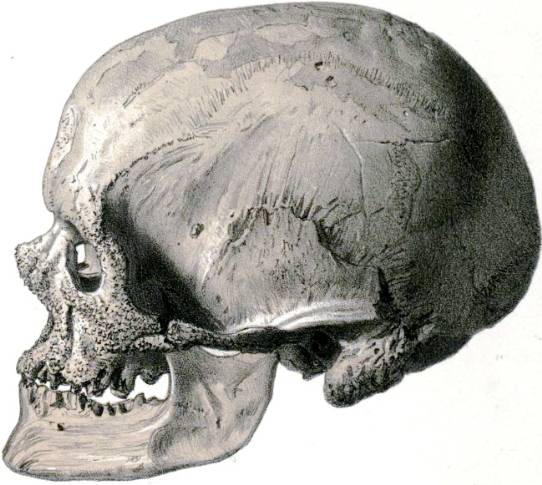
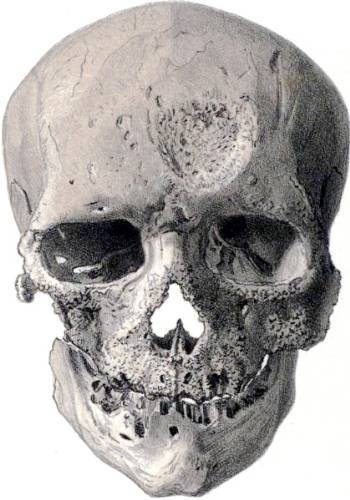
The original Cro-Magnon skull, the "old man," shown here in lateral and anterior aspect, was found in Périgord (a former French province occupying roughly the same region as today's department of Dordogne) in southwestern France in 1868. During the removal of talus for use in road construction, a rock shelter, which became known as the Cro-Magnon Cave, was exposed at the base of a cliff near the village of Les Eyzies (modern Les Eyzies-de-Tayac-Sireuil).
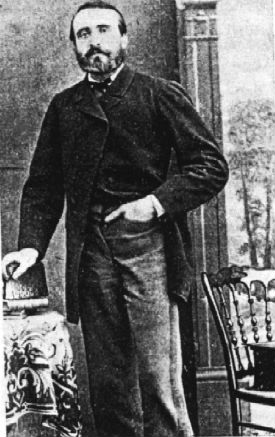
The skeletons of an old man and four other individuals were collected from the site by Louis Lartet, the son of Éduoard Lartet, who was also a geologist and pre-historian. Much of the facial surface of the skull is roughened by the calcareous drip to which it was exposed while lying in the cave. The Cro-Magnon Cave lies in the Vézère Valley, site of many other prehistorically occupied caves and rock shelters. Lartet also found many traces of human occupation at the site.
For many years Cro-Magnon was the name scientists used to refer to humans of the type now formally termed European Early Modern Humans (EEMH), that is, early modern humans of the European Upper Paleolithic. The earliest known remains of Cro-Magnon-like humans are radiocarbon dated to 43,000 years before present.
Cro-Magnons were robustly built, but the forehead did not slope like a Neanderthal's, nor were there prominent brow ridges, as in Neanderthals. They also differed from Neanderthals in having a prominent chin. In fact, from what can be determined from their bony remains, Cro-Magnons are hard to distinguish from modern human beings.
Most shared on Macroevolution.net:
Human Origins: Are we hybrids?
On the Origins of New Forms of Life
Mammalian Hybrids
Cat-rabbit Hybrids: Fact or fiction?
Famous Biologists
Dog-cow Hybrids
Georges Cuvier: A Biography
Prothero: A Rebuttal
Branches of Biology
Dog-fox Hybrids