On the Origins of New Forms of Life
4.10: Symbiosis
(Continued from the previous page)
|
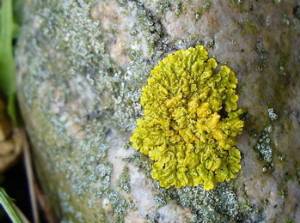
| A Yellow Lichen |
Production of Symbiotic Associations. In symbiosis, organisms form permanent associations. Many such associated pairs are treated as species. Thus, Margulis and Schwartz (1998: 364) say at least one-quarter of all fungi treated as species enter into associations with photosynthetic microbes to form lichens and that some 13,500 of these lichens have been treated as species distinct from the forms that compose them. This practice is common because a lichen usually looks entirely different from the fungus and alga that unite to produce it. Though such composite forms are not the products of chromosomal mutations, the production of a symbiotic association is a type of stabilization process because it produces a new stable type of organism with a stable reproductive cycle. (Note that the process producing such forms is analogous to hybridization even if it is not, strictly speaking, hybridization itself, inasmuch as it involves the melding of two distinct forms. Moreover, such organisms commonly exhibit emergent or synergistic traits, as do ordinary hybrids.)
A special form of symbiotic association can exist between cells, in which one type of cell lives inside another. Many biologists believe the complex cells characteristic of eukaryotes first arose when non-nucleated bacteria engulfed other bacteria to create compound organisms that thenceforward existed as single, symbiotically cooperative organisms. This fusion of bacteria is known as symbiogenesis or endosymbiosis. Indeed, Margulis and Schwartz (1998: 111) go so far as to say that "All protoctists [i.e., simple eukaryotes] evolved from symbioses between at least two different kinds of bacteria--in some cases, between many more than two."
Most shared on Macroevolution.net:
Human Origins: Are we hybrids?
On the Origins of New Forms of Life
Mammalian Hybrids
Cat-rabbit Hybrids: Fact or fiction?
Famous Biologists
Dog-cow Hybrids
Georges Cuvier: A Biography
Prothero: A Rebuttal
Branches of Biology
Dog-fox Hybrids